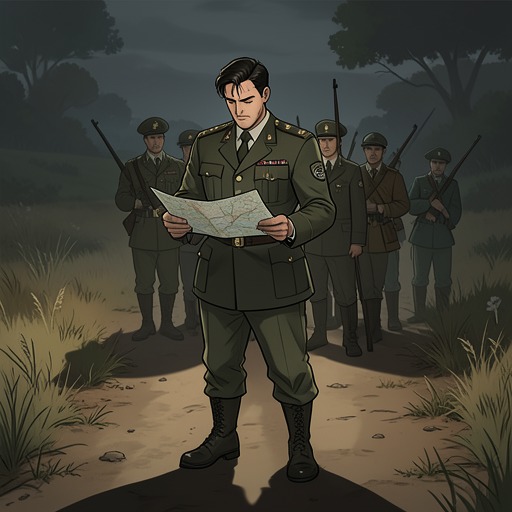
Tenji Nakamura’s fugitive period
The Narrow Road to the Deep NorthTenji Nakamura’s fugitive period begins in the ruins of postwar Tokyo, where the former railway-regiment major survives by salvaging timber and selling it for charcoal. A newspaper naming him as a possible Class B war criminal turns precarious survival into a flight from arrest. He escapes to Kobe under false papers and the name Yoshio Kimura, living by petty theft and black-market trade. His eventual return to his real name marks a change in how he chooses to live, but not a reckoning that resolves his responsibility for the deaths he oversaw.
Ruins and the warrant
Demobilised two and a half months earlier, Nakamura finds himself amid the physical and social wreckage of postwar Tokyo. He is glad to be insignificant there, but has little to live on: he pulls timber from damaged buildings and sells it to a charcoal burner. A newspaper picked up from the ground interrupts this routine. Its report concerns American warrants for former POW-camp staff in connection with possible war crimes. Halfway down the list of suspects, Nakamura finds his own name and sees that he is considered a possible Class B war criminal.
He rejects the accusation, regarding himself as no war criminal and the Americans as the true perpetrators. Yet his anger does not remove his fear. He believes the Americans are pursuing former camp personnel methodically and that those connected with POWs are especially exposed. He is determined not to be captured or executed, and the possibility of arrest makes the ordinary difficulties of survival—finding food and earning a living—part of a larger danger.
The prospect closes in as he takes stock of his situation. Salvaging timber cannot sustain him; his crowbar is damaged, and he is hungry in the cold. He realises that the Americans have been following leads for days and imagines his own death if they catch him. For a moment, he considers suicide as the honourable alternative. Before he acts on that decision, muffled shouts draw his attention away from it. The interruption leaves him alive to choose another course: escape and concealment.
A borrowed identity
Nakamura uses money stolen from a pan-pan girl to buy false identity papers. He sells her clothes to another pan-pan and uses the proceeds to buy a train ticket to Kobe. In a third-class carriage, he leaves Tokyo and his identity as the former railway-regiment major Tenji Nakamura behind, travelling as Yoshio Kimura, an ex-IJA private. The new name offers a way to evade the search, but it does not offer security or a new life free of the war.
Kobe is no refuge from the devastation. Nakamura makes a hand-to-mouth living through petty theft and black-market dealing, and continues to feel unsafe. On one occasion he thinks he recognises, at a distance, a tall Australian officer from a POW camp. Whether or not the man has identified him, Nakamura’s fear governs his movements: for a week he ventures onto the streets only at night. His flight therefore changes his location and his public identity without ending his sense that the past may catch up with him.
Trials, return, and the limits of change
Nakamura follows the war-crimes trials closely. He reads that a Japanese soldier who repeatedly beat an escaped POW has been convicted and hanged, and finds the punishment difficult to fathom. The contrast is stark: he fears arrest as a suspected offender, yet struggles to understand the severity of a judgment against another man for mistreating a prisoner. His reactions reveal the distance between the danger he faces and his own account of wartime conduct.
His concealment ends only after the remaining imprisoned war criminals are released. As he grows distant from Sato, Nakamura becomes closer to other people and finds himself able to be more truthful. He recognises others who, like him, see themselves as proud men who did their duty and were also victims of the war. The period in which people hid who they were and remembered only what could be spoken about has, he feels, passed. He gives up the pretence, resolves to live honourably by acknowledging the truth, and resumes his real name. The following year he marries Ikuko Nakamura.
Memory and responsibility
The end of Nakamura’s fugitive period is a change of identity and intention, not a clear confession or an account of all that he did. He had overseen many deaths and sometimes felt an almost savage pride in his part in them, yet he felt no responsibility. Over time, memory eroded his sense of his crimes and sustained stories of his goodness and of circumstances that might excuse him. The novel leaves the contradiction intact: the man who chooses to stop hiding can still live with a self-understanding that does not fully confront the deaths attached to his wartime role.
That contradiction gives his flight its larger significance. False papers and an assumed name make literal the postwar effort to escape the past; resuming his real name appears to end that evasion, but cannot by itself settle what responsibility requires. Nakamura’s movement from Tokyo to Kobe and back to his own identity is therefore neither a simple redemption nor a complete exposure. It is a transition from concealment toward truth, shadowed by the gap between acknowledging one’s name and accepting the full weight of one’s actions.